Claude
Debussy
was a visionary French
composer and pianist
whose revolutionary
approach to harmony,
rhythm, and
orchestration
transformed the
landscape of Western
classical music at the
turn of the 20th
century. Frequently
associated with the
Impressionist movement
in art—a label he
personally
rejected—Debussy broke
away from the rigid
structural formulas of
traditional Germanic
Romanticism. By
treating chords not
just as functional
links in a harmonic
chain but as
independent colors and
sensory experiences,
he paved the way for
modern music.
Early
Life and Prodigious
Beginnings
Achille-Claude
Debussy was born on
August 22, 1862, in
Saint-Germain-en-Laye,
France, into a modest
family. His parents
owned a china shop,
and his childhood was
mostly devoid of
musical influences.
However, his innate
talent was discovered
early by his first
piano teacher,
Antoinette Mauté de
Fleurville, who
claimed to have
studied under Frédéric
Chopin.
In 1872,
at the remarkably
young age of ten,
Debussy gained
admission to the
prestigious Conservatoire
de Paris.
He spent more than a
decade there, studying
piano and composition.
While his exceptional
skills as a pianist
were undeniable, his
professors were often
baffled and aggravated
by his rebellious
streak. Debussy
frequently challenged
the academic orthodoxy
of the era,
deliberately creating
dissonances and
unconventional chord
progressions that
defied traditional
music theory. When
asked by a professor
what rule he followed
when composing, the
young musician
famously replied, "Mon
plaisir" (My
pleasure).
The Prix
de Rome and Artistic
Awakenings
Despite
his anti-academic
tendencies, Debussy
won France’s highest
musical honor, the Prix de
Rome,
in 1884 for his
cantata L'enfant
prodigue.
The prize funded a
mandatory three-year
artistic residency at
the Villa Medici in
Rome. Debussy found
his time in Rome
stifling, describing
the environment as a
prison and
experiencing periods
of deep creative
depression. He cut his
stay short and
returned to Paris in
1887.
Back in
the vibrant cultural
hub of Paris, Debussy
found his true
inspiration outside
the walls of the
conservatory. He
immersed himself in
the avant-garde
literary and artistic
circles of the city,
attending the famous
weekly salons hosted
by the Symbolist poet
Stéphane Mallarmé.
Debussy felt a deeper
kinship with Symbolist
poets and
Impressionist painters
like Claude Monet than
he did with
contemporary French
composers. He sought
to achieve in music
what they were
accomplishing with
words and
brushstrokes:
capturing transient
moods, fleeting
sensations, and the
raw essence of nature.
Two
pivotal experiences in
the late 1880s
permanently altered
his musical
trajectory. The first
was his exposure to
the monumental operas
of Richard Wagner,
which deeply impressed
him but also convinced
him that French music
needed to find its own
distinct voice away
from German dominance.
The second, and
perhaps most
influential, was his
encounter with the
Javanese Gamelan
ensemble at the 1889 Paris
Universal Exposition.
The hypnotic, layered
percussion,
unconventional scales,
and non-Western
structures of the
Gamelan opened up
entirely new sonic
possibilities for him.
Masterpieces
of Mature Innovation
By the
1890s, Debussy had
fully synthesized
these diverse
influences into a
completely original
style. In 1894, he
achieved definitive
artistic maturity with
the premiere of Prélude à
l'après-midi d'un
faune
(Prelude to the
Afternoon of a Faun),
a symphonic poem
inspired by a poem by
Mallarmé. The piece
begins with a famous,
floating flute solo
that immediately
dissolves traditional
boundaries of key and
rhythm. This single
work is widely
considered by
musicologists to mark
the birth of modern
orchestral music.
Debussy
continued to produce
groundbreaking works
for both the orchestra
and his primary
instrument, the piano.
His only completed
opera, Pelléas et
Mélisande
(1902), stunned the
musical world with its
understated, dreamlike
atmosphere and
speech-like vocal
lines, providing a
stark contrast to the
heavy dramatic style
of Wagner. In 1905, he
unleashed his
orchestral
masterpiece, La Mer
(The Sea), a sweeping,
three-movement tonal
depiction of the ocean
that showcased his
unmatched brilliance
in orchestration.
As a
pianist, Debussy
revolutionized
keyboard technique.
His two books of Préludes
(1910, 1913) and his Suite
bergamasque—which
contains the
universally beloved,
moonlit masterpiece Clair de lune—demanded
a fluid, legato touch.
He instructed pianists
to play as if the
piano were an
"instrument without
hammers," focusing
heavily on the subtle
use of the sustain
pedal to create vast,
overlapping washes of
sound.
Turbulent
Personal Life and
Final Years
While his
professional
reputation grew across
Europe, Debussy’s
personal life was
often chaotic and
fraught with scandal.
He engaged in
tempestuous romantic
affairs, including a
ten-year relationship
with Gaby Dupont,
which ended bitterly.
In 1899, he married
Marie-Rosalie "Lily"
Texier, a dressmaker.
However, in 1904,
Debussy deserted her
for Emma Bardac, an
intellectual and
accomplished singer.
The emotional fallout
was severe; a
devastated Lily
attempted suicide by
shooting herself in
the chest, sparking a
massive public scandal
that alienated many of
Debussy’s closest
friends. Debussy and
Bardac eventually
married and had a
daughter, Claude-Emma
(affectionately
nicknamed "Chouchou"),
to whom he dedicated
his charming Children's
Corner
suite in 1908.
The final
decade of Debussy's
life was shadowed by
failing health and the
geopolitical
catastrophe of World
War I. In 1909, he was
diagnosed with
colorectal cancer,
which progressively
sapped his energy. The
outbreak of the war in
1914 deeply distressed
him, prompting him to
sign his late
compositions proudly
as "Claude Debussy,
musicien français."
Despite his intense
physical suffering, he
continued to compose,
focusing on a planned
cycle of six sonatas
for various
instruments, though he
only lived to complete
three.
On March
25, 1918, Claude
Debussy passed away at
his home in Paris at
the age of 55. Because
Paris was under active
bombardment by German
artillery at the time,
his funeral procession
through the deserted
streets was a somber,
hurried affair. He was
initially buried at
Père Lachaise Cemetery
but was later moved to
the Passy Cemetery,
where he rests today.
Tragically, his
beloved daughter
Chouchou died of
diphtheria just a year
later.
A Lasting
Musical Legacy
Debussy’s
impact on 20th-century
music cannot be
overstated. By
liberating music from
the strict laws of
traditional tonal
harmony, he paved the
way for subsequent
radical movements,
including the
abstraction of Igor
Stravinsky, the
atonality of Arnold
Schoenberg, and the
ambient textures of
minimalist music. His
brilliant use of the
whole-tone,
pentatonic, and modal
scales forever changed
how composers
structured melody and
form. Today, he is
celebrated not merely
as a giant of French
culture, but as the
foundational architect
who boldly ushered
classical music into
the modern era.
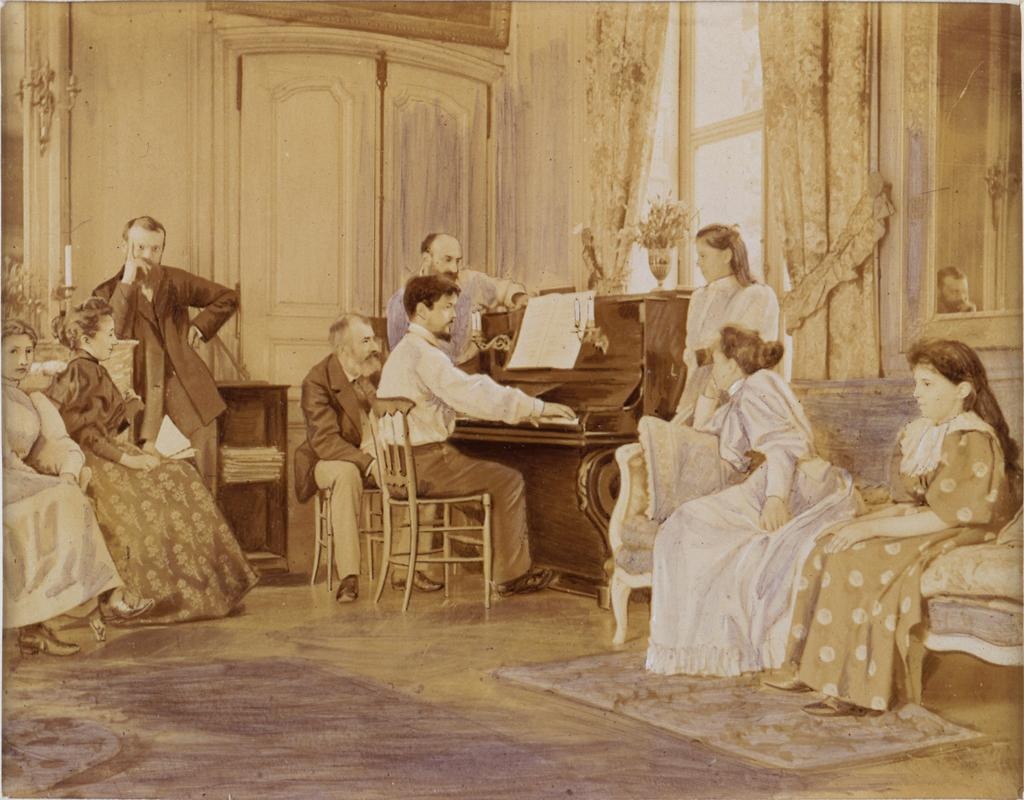
Top
Photo: Claude
Debussy at the piano
in the summer of
1893 at the house in
Luzancy (at the home
of his friend Ernest
Chausson). From left
to right: Yvonne
Lerolle, Mme
Lerolle, Raymond
Bonheur, Henri
Lerolle, Ernest
Chausson, Claude
Debussy, Christine
Lerolle, Mme
Chausson, Étiennette
Chausson.
Free
piano sheet music - Piano
lesson - Grand piano - Piano
mover - Yamaha piano - Digital
piano -
Baby grand piano - Piano
keyboard - Antique piano -
Upright piano - Player piano -
Piano man peter edwards - Used
piano